 Deutsch

Flip Concrete Slabs—Without Lifting Frames, Chains, or Forklifts
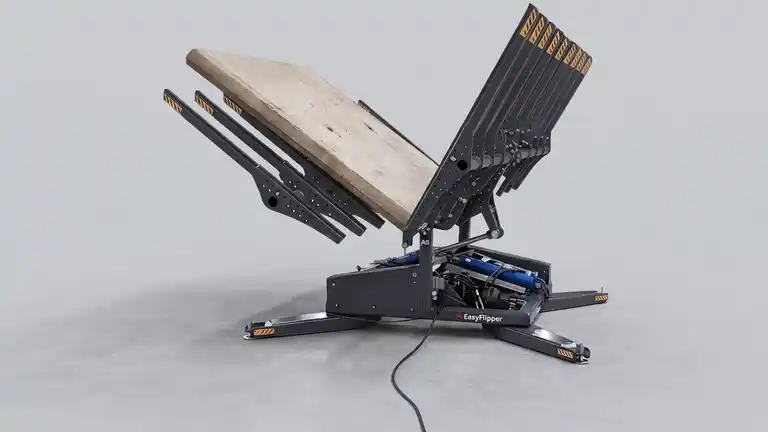
Freshly cast concrete slabs leave the mold with the rougher side facing up, while the smoother, higher-quality surface remains against the mold. Once the concrete has cured, the slab must be flipped to bring the finished face to the top. The EasyFlipper automates this step.
Why Conventional Flipping Methods Reach Their Limits
Concrete slabs are typically flipped using one of three methods—all of which keep a forklift or crane and its operator tied up throughout the process.
A yoke frame mounted on the forks of a forklift suspends the slab by a chain and rotates it.
A forklift-mounted clamp grips the slab and rotates it.
Uses suction to lift the slab and turn it with the vacuum lifting system.
The slab remains fully supported throughout the flipping process—without chains, clamps, or suction points. This protects the finished surface while it is still newly exposed and sensitive.
What Makes the EasyFlipper Different for Concrete Slabs
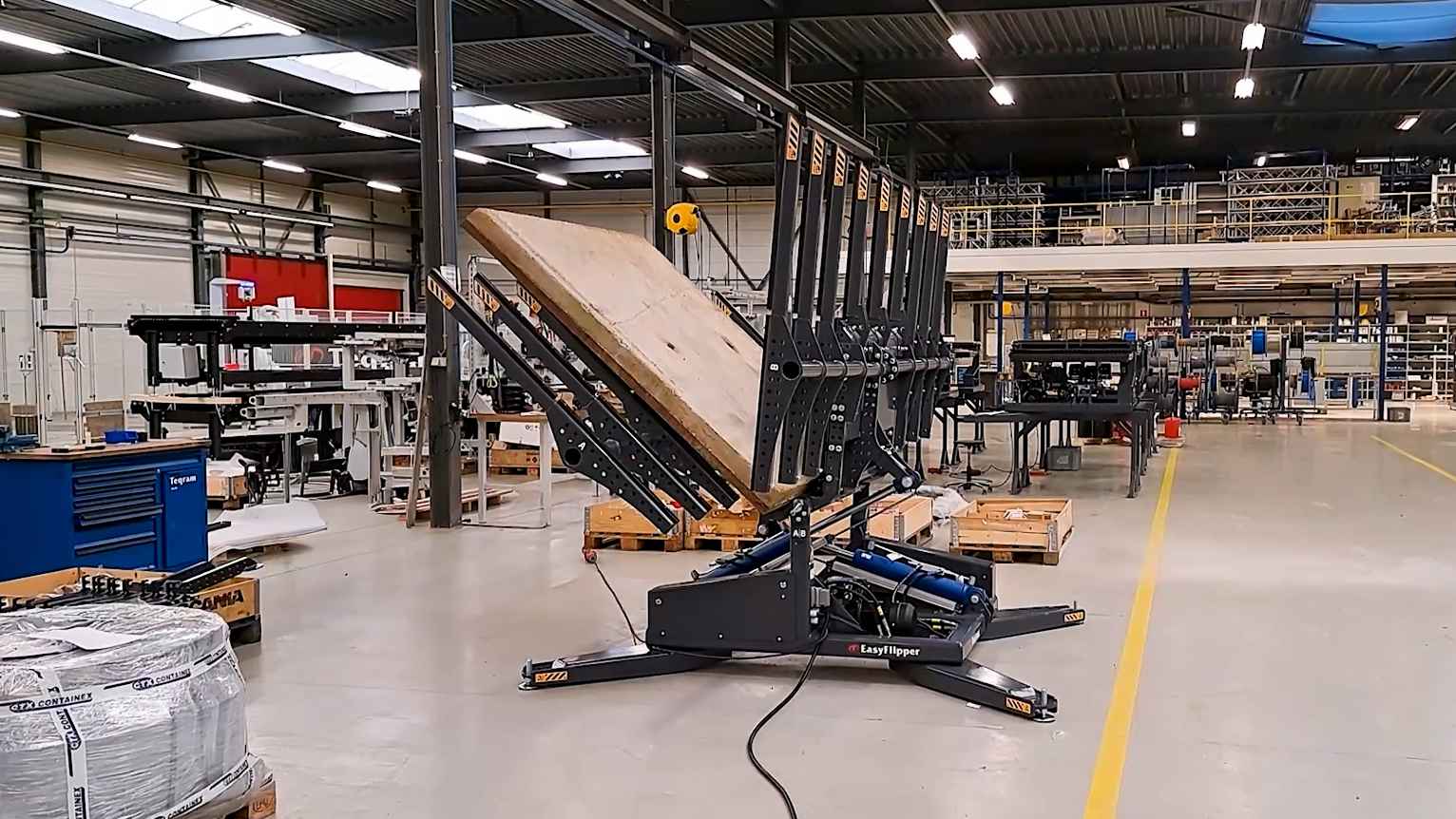
The slab is placed on the EasyFlipper table—not suspended, clamped, or held by suction. Throughout the flipping process, it remains fully supported on a padded surface while being rotated 180° in a controlled motion.
Benefits of the EasyFlipper for Concrete Slabs
Protects the Finished Surface
The slab remains fully supported instead of being clamped or lifted by suction at isolated points—important while the surface is newly exposed and sensitive.
No Forklift or Crane Required
Flipping becomes a separate process step, leaving the forklift, crane, and their operators available for other tasks.
Consistent Process for Every Slab
Unlike attaching chains or positioning a clamp, the flipping process is performed the same controlled way every time.
Adjustable for Different Slab Sizes
Extension arms allow the table length and width to be adjusted—from small paving slabs to large-format floor slabs.
Typical Workflow in Precast Concrete Production
The EasyFlipper can be integrated directly into the production workflow—for example, immediately after demolding or before a subsequent surface-finishing process.
Is the EasyFlipper Right for Your Concrete Slab Sizes?
Slab dimensions, weight, and production volume determine which EasyFlipper model and table size best fit your operation. Full technical specifications and detailed operating information are available on the EasyFlipper main page.
Ready to Start Flipping Concrete Slabs?
